Pages

Monday, 11 April 2022

Who are the Croods

  •  They both walk bipedally and knuckle walk.
  • They are wearing animal fur for clothing.
  • they do not use weapons until the end of the movie.
  • They have robust bone structure and muscles. 
  • Very hard cranium. 
  • They are mostly scavengers 
  • High level of language
  • They domesticated animals.
  • They made cave art

Through these points, I think that they are homo neanderthalensis.
Guy is probably a homo sapien as he is able to think more and has a less stocky build.

Tuesday, 1 September 2020

Rendering Internal

 https://www.nzqa.govt.nz/nqfdocs/ncea-resource/achievements/2019/as91066.pdf

For the past few weeks, we have been learning to render drink bottles of our design. 

These are my drink bottles.

While doing this, I enjoyed that I could just sit down and colour in my bottle. I also enjoyed learning how to render.

While doing this, I disliked how we were using the same design that we came up with at the start of the year.


Monday, 23 March 2020

Film techniques - Over the shoulder shot

What is the effect of an over the shoulder shot?
The over-the-shoulder shot shows the connection between characters.

What film aspect shows a disconnection between characters?
When both characters are no longer in the same shot together. Instead, they are in a single close up.

How does the director of this scene show the disconnect of characters?
The director does this by putting the camera on a dolly. While the characters are talking, the camera is slowly moved forward to change the shot from an over-the-shoulder-medium shot to a single-medium-close-up shot. Once they are no longer in the same shot, it means that they are no longer on the same page.

What eventually totally isolates the female character?
Although they are no longer in the same shot, both characters are still connected to the waiter, who is shown on the edge of the medium-close-up shot. She becomes completely isolated when the medium-close-up shot that was facing her changes to a close-up of just her, while the shot facing the male character does not change. This shows that the male character still has a connection with the waiter but the female character is now completely alone.

Film techniques - Tone

How does tone work in a film

What else can we call tone in a film?
The way the film makes the audience feel.

What are the three main elements of tone?
The three main elements of tone are lighting, exposure, and art direction. Lighting is the contrast of the scene. By darkening the figure of a person, they can be seen as dangerous. Exposure is the different levels of light contained in each section of the scene. When one section of the scene is much brighter than the other, it shows that this part of the scene is happy, while the other is ominous and dark. Art direction is the tone of the background. A brighter toned background can be seen as inviting, while a darker background can be seen as dangerous.

How and why does Coppola use tone in the classic film "The Godfather"?
An example of Coppola using tone in during the first shots of "The Godfather". To create an ominous, mysterious, and dangerous feeling, he made the whole scene dark, making it hard to tell what was going on. These underexposed scenes made it so that any bit of light had an impact on the scene.

How can the directors control the feelings of the scene?
By changing the tone of the scene. Either by darkening or brightening the scene. 

Monday, 17 February 2020

Mini-writing no.1

Have you ever been in a room full of people, some buy needs help, but nobody decides to help him. That
sitution is caused by what is called the Bystander Effect. In such situations, It gives us thoughts like “someone else will help them” or “I’m not the right person to help them. And because everyone thinks that way, no one ends up helping. To solve why this occurs, an experiment was carried out where different amounts of people were brought into a room to fill a survey, while a man struggles to set up a tent. The purpose of the experiment was to measure the amount of time it took for someone to help him. The experiment was first done with ten people. After repeating the experiment seven times, the result was that it took an average of 8 minutes and 1 second for someone to stand up and help him. Next, it was done with 5 people. After repeating the experiment seven times, the average time was 7 minutes and 25 seconds. Lastly, it was done with one person and the average time was 3 minutes, the fastest time being only 12 seconds. The conclusion to this experiment was that the more people there are in the room, the responsibility to help the man out was diffused, meaning it was spread out. They called this the diffusion of responsibility.

Tuesday, 26 November 2019

more treaty of Waitangi stuff

Article one:
On the Maori version the Chiefs gave up governorship over New Zealand to the British. On the English version, The chiefs gave up sovereignty, meaning that they gave up all of New Zealand over to the British.

Article two:
On the English version, Maori had their possession over their land, estate, forests, fisheries, and some other stuff. On the English version, basically everything was handed over and the Maori could only sell their lands to the British and no one else.

Article three:\
On the english version, The Maori were granted the same rights as British people. On the Maori version, the Maori were offered protection from the Crown, as well and the same rights as British people.

Friday, 22 November 2019

Treaty of Waitangi stuffs

In 1830 there were 100000 Māori and 100 Europeans living in New Zealand. In 1840, the treaty was signed. There were many reasons for this, but the four main reasons are the lawless behaviour of the Whalers on Kororareka, the desire of the Missionaries’ to help protect Maori rights, the Musket Wars that were occurring all over the country, as well as the existence of the Declaration of Independence.

One reason that a treaty was needed was the lawless behaviour of some British Settlers such as Whalers. This is important because the lawless behaviour gave places like Kororareka (The biggest New Zealand port at the time) a bad reputation. Kororareka even became known as the hell hole of the Pacific. At the time, the British did not have the authority to enforce their laws and bring their police force to New Zealand. So when around 300 Sailors, from up to 12 ships came ashore, no laws were binding the Sailors. Once the Sailors came ashore, their activities were basically nothing but drinking, fighting, and sex with prostitutes. This might not sound like it was a big deal, but all of this was done at an extreme level, to a point where people were actually dying. This lawless behaviour concerned both the Maori chiefs as well as the Missionaries and led them to sign the Treaty of Waitangi.

Another reason for the creation of the treaty was the Missionaries intentions to protect Maori rights. During that time, the Europeans were buying land everywhere they could. This worried the Missionaries because the land owned by Maori were getting smaller and smaller. The Missionaries did all they could to help the Maori chiefs that were constantly getting pushed into selling their land, they bought patches of land for them. They did this because it would mean that the Maori could live in peace, without the threat of the Crown buying their land, as well as gain the trust of the Maori. Then came the Treaty of Waitangi. The idea of the treaty was that the land occupied by Maori tribes would be left undisturbed. The Missionaries thought the treaty would help the situation, so they supported it. And because they had gained the trust of the Chiefs, they convinced them to do so as well.

Ever since the introduction of the musket at the beginning of the 19th century, wars fought by Maori completely changed. Because the wars were fought with such powerful weapons, the death count was around 20000 Maori. Traditional weapons such as Taiaha became useless at the face of muskets, and tribes without muskets needed to do whatever they could to obtain them. The amount of power a tribe had largely depended on the number of muskets they owned. The trading requirements for muskets varied depending on the year, however, it could cost the Maori up to 200 full baskets full of potatoes for a single musket. The cost was extremely high but tribes had no choice but to trade. To trade for more muskets, Maori replaced much of their usual crops with potatoes. Changing their way of life. In the 1830s all the tribes had muskets, and a balance in power occurred between the tribes. But up until that point, tribal boundaries were constantly shifting and many Maori died. The constant musket wars between the Maori made it apparent that laws were mandatory. And to enforce those laws, they needed more authority. The need for laws and authority were contributing factors to the signing of the treaty.

The final reason that a treaty was needed was the existence of the Declaration of Independence. In 1835 the Declaration of Independence was created. The declaration gave all the power to the Maori in exchange for the exclusive trading rights with the British. If any changes were to be made, it would have to go through the Maori first. This was great for Maori and Europeans, but because the Maori had all the power, it meant that the British couldn’t do whatever they wanted. To gain back the power over New Zealand, the Europeans suggests the treaty.

In the end, the four main reasons for the signing of the treaty were the need for police to control the lawless behaviour of the Whalers around Kororareka, The strong desire that the Missionaries had to help the Maori, The need for laws to stop the death and enslavement of Maori, caused by the Musket War, and the existence of the Declaration of Independence. I personally feel that New Zealand didn’t need the treaty. If they needed laws and a police force, the Maori could have set one up. Although the Maori were losing large amounts of land, it was nothing compared to the amount of land they lost after the treaty, and just like any other war, the Musket Wars would have stopped eventually. So in the end, the treaty wasn’t even needed. Everything would have sorted itself out eventually.

Thursday, 21 November 2019

Pulleys

How do pulleys work?
To understand how pulleys work, we must first understand the equation 'Work equals distance multiplied by force'. When it comes to pulleys, the work is the amount of energy required to move the object, the distance is how far the object is moved, and the force would be the mass of the object multiplied by the Earth's gravity. Work will always equal the product of distance and force. That means, if the distance is increased, the force will have to decrease to compensate. When using pulleys, the weight of the object is supported by multiple ropes. This means that all the ropes supporting the object will have to be moved further but the force that is supported by the ropes will decrease.

Some other stuff:
Force = mass x acceleration
The mass of the object is measured in kg and the acceleration is 10ms−2  due to gravity. The force is measured in Newtons.
Work = Force x distance
The force is measured using the equation above and the distance is how far the object is moved. It is usually measured in meters. Work is measured in Joules.
The mechanical advantage of using pulleys
The amount of force will be divided between all the ropes that are connected to the object.
The amount of force on one rope will be equivalent to the other rope.

In this photo, the force required to lift the object is 100N (Newtons).

If you were to move the object up 4 meters, it would take 400 Joules of energy.
Both point A and B are being pulled by 100N of force.


Normally, It would require 100N of force to lift this object, but because it is supported by 2 ropes, the force is divided. And because point B has 50N on it, point A would also have to have 50N to balance it out. 

The amount of work required to lift the object up 4 meters is still 400 joules of energy. You might ask why that is since it only takes 50N of force. Well, this is because, in order to move the object up by 4 meters, the length of both rope B and C must decrease. In order for that to happen, Point A must be pulled twice as far.
Thus resulting in the same amount of work. The main point of using a pulley in not to decrease the work, but to make it easier. This is done simply by decreasing the force required to move the object, as well as increasing the distance in which you have to pull on the rope.

Monday, 18 November 2019

Seismic waves

Seismic waves
Seismic waves are waves of energy that travel through the Earth as a result of earthquakes, volcanic eruptions, as well as man-made explosions. There are many types of seismic waves, each moving in different waves. The two main types of Seismic waves are called body waves and surface waves.


Body waves:
Body waves travel through the interior of the Earth, they have a higher frequency than Surface waves, and they arrive before the Surface waves are emitted by the earthquake. There are two types of Body waves: The Primary wave, and the Secondary wave. Each of them shakes the ground in different ways.


Primary waves
Image result for P waveThe Primary Wave, or the P wave, is the fastest kind of Seismic wave and can travel from 5km to 8km per second, depending on the density of the medium. As a result, they are the first to be felt. P waves, unlike S waves, are able to travel through both solid and liquid layers of the Earth. Much like how Sound waves, P waves travel by compressing and dilating (Pushing and Pulling) the medium. The pushing and pulling produces a back and forward motion towards the direction of wave propagation, which is the direction that the energy is travelling in. Because of the pushing and pulling it does, the P Wave is also called the Compressional Wave.

Image from http://allshookup.org/quakes/wavetype.htm


Related imageSecondary Waves
The Secondary Wave, or S Wave, is the second wave you feel during an earthquake. It is slower than the P Wave and, unlike the P Wave, it can not travel through liquid mediums and can only travel through solid ones. Seismologists were able to conclude that the Earth's outer core is a liquid. They were able to do this because P Waves could be felt of the opposite side of the earth but S Waves could not. S waves move the rock particles up and down, or side to side, perpendicular to the direction of the wave propagation.

Image from https://www.thinglink.com/scene/581579679287214082


Surface waves:
As the name suggests, Surface waves travel only through the crust. They are of a lower frequency than body waves and arrive after the Body waves. Although they arrive after the Body waves, almost the entirety of the damage caused by an earthquake is the result of Surface waves. There are two types of Surface waves: the love wave, and the Rayleigh wave.

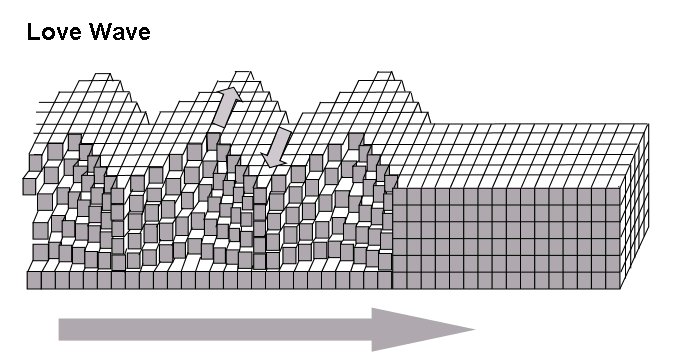
Image result for love waveLove wave
In 1911, a British mathematician named A.E.H. Love worked out the mathematical model for this kind of Surface wave. As a result, this wave was given the name 'Love wave'. The S wave moves the ground either up and down, or side to side. The Love wave is basically the same but it only moves it from side to side, not up and down. The Love wave is also the fastest kind of surface wave. They generally travel from 2 to 6 kilometers per second.


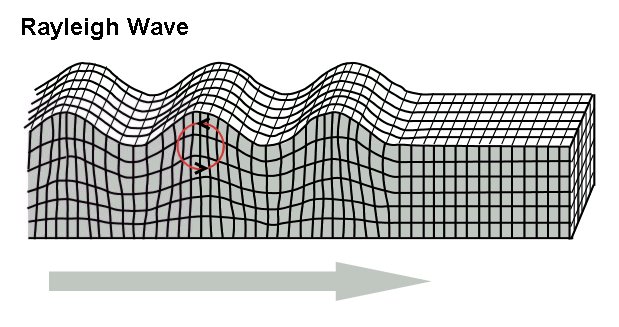
Image result for rayleigh waveRayleigh wave
The Rayleigh wave is the other kind of Surface wave. It was named for John Willian Strutt, Lord Rayleigh, who, in 1885, mathematically predicted the existence of this kind of wave. Rayleigh waves are also known as ground roll because it rolls. Similar to ripples and waves on the ocean surface, Rayleigh waves spread through the ground as ripples, moving both vertically and horizontally. Most of the shaking during an earthquake is because of the Rayleigh wave.

Friday, 8 November 2019

Treaty of Canandaigua

Trust me, this page has work on it.


I have researched the treaty of Canandaigua. This is related to the topic of Waitangi because they are both treaties to stop the violence.

Friday, 1 November 2019

Line graph of thing


Questions:

1. What does this graph show us?
The graph shows how the Maori population consistently drops while the European population increases.

2. Why do you think the numbers of Maori change?
When guns began to be traded, musket wars between Maori tribes began.

3. Why do you think the numbers of Europeans changed?
The treaty of Waitangi.

Friday, 25 October 2019

Part of a story

I live in a world full of lies. All everyone tells me are lies. My entire world is a lie. It wasn't always like this, you know. It's faint, but I still have memories of the days when everything was fine. Every morning, id wake up with a smile on my face and run down to see my parents. I would say "Good morning Mum and Dad", and they would always reply with "good morning sweetie, how is your day going". All of this was 10 years ago. I was a 5-year-old kid who knew nothing of the world. I also didn't know about the greed in a human heart, and that was my ultimately my downfall.
My father owned a company that sold electronics and earned massive amounts of money each year. When he created this company, he writ that if he were to die, the company would go to his eldest child. Doing this ensured that if he got into an accident and passed away early, his family would still have income. Doing this sounds like a good idea right, I thought so too, but it wasn't. To him, it was a way to keep his family safe. But to his employees, it was a way to take over his company.

Wednesday, 18 September 2019

Term 3 food

This term we have been looking at a cultural unit. So far, I have learned how the migration of other countries has impacted food consumption in New Zealand. Also, I have learned about the different animals, plants, and techniques that the European's brought along to New Zealand. Practicals we have made this term are Scones, Jamdrops, pad Thai, Souvlaki, Pizza, Sushi, and fish and chips. The main point of making all these dishes was to learn about different foods and techniques from all around the world. Some were from European countries, and some were from Asia. All these different foods, from all around the world have made it to New Zealand due to the migration and settlement of different cultures. Throughout the many practicals, we have done, I have improved basic skills such as the different ways to cut vegetables, and stir-frying. I am sure that I will use these skills in the future once I move out of my house. I'd say that the group that I cooked with was reliable and didn't do anything stupid. :)

Wednesday, 28 August 2019

Pizza making in Food Tec

Currently, during home economics, we are learning about the change of food in NZ. During our last practical in food tec, we made pizza.

Ingredients: 
1 cup self-raising flour (or 1 cup plain flour and 1 teaspoon of baking powder)
1 cup unsweetened yogurt
½ tsp salt
Making the Dough:
1. In a bowl combine all ingredients.
2. Bring together to form a ball.
3. Turn out onto a floured board. Knead and roll the dough for 5-8 minutes.
4. Break into even parts for each person in your group.
5. Roll into an oblong or round shape

To make your homemade pizza:
1. Pre-heat oven to 200 degrees Celsius.
2. Spread tomato paste onto the pizza base.
3. Add your favourite toppings eg, cheese, tomato, red onion, basil
4. Bake for 10 minutes or until cooked.

Tuesday, 20 August 2019

Screen time in HH


While working in this I found out that in my class, there is really no inbetweeners. It is either they go on devices a lot, or they don't use it much at all. 

Monday, 19 August 2019

Change in food over time

NO Image found....

1. How has food changed in the last 100 years and what have been the big reasons for this change?
Over the last 100 years, food in New Zealand has changed significantly. The main reason being the arrival of the European settlers. Before the European's arrival, the Maori were the only humans living in New Zealand. Only gathering what is necessary, they caught fish and eels using traps, berries from bushes and hunted birds, such as the Moa using weapons made of bone, stones, and flax. They cooked their food in a hungi, a method where they put the meat and vegetables in a hole in the ground and placed hot stones under the food. When the Europeans arrived, cows, chickens, and sheep were introduced as a new food source. And food was cooked in an oven. The most common meal was the one meat and 3 veg. Now days, we have different foods from countries all around the world, different cooking methods, and we have fast food joints around every corner.

2. What was something you didn't know about changes in Nz Food that you learned from the cards? IDK....


3. What could you see happening to food in another 50 years time?
In 50 years time, I think that we will have liquids that fulfil all our daily nutrient needs.

4. What could you invent or change that would create a large impact on how we gather produce or eat food?
Drinks.

Tuesday, 13 August 2019

Electrochemical Cell (Galvanic cell)

Aim: To create an Electrochemical cell (Galvanic Cell) and measure its voltage.


Equipment: copper metal (Cu), copper nitrate (Cu2+ NO¯3), Zinc metal (Zn), Zinc nitrate (Zn2+ NO¯3), a salt bridge (paper towel and sellotape, Potassium nitrate (K+ NO¯3) 2x 250ml beaker, a 100ml beaker, a voltmeter, metal scrub, wire.


Method:
1. Grab the metal scrub and wipe off the black exterior of both the zinc metal and the copper metal. Then put them in separate 250ml beakers.


2.  Fill up the beaker containing the Copper metal with copper nitrate. Likewise, fill up the beaker containing the Zinc metal with Zinc nitrate.


3. Fill up the 100ml beaker with the Potassium Nitrate.

4. Get a paper towel and repeatedly fold it until it is a long strip. Then wrap sellotape around the strip of paper towel to keep it from loosening up.

5. Bend the strip of paper towel into a U shape and put it into the 100ml beaker until the strip is completely soaked.

6. Connect both metals to the voltmeter.

7. Place one end of your paper towel strip into the beaker containing the Copper nitrate, and place the other end, into the beaker that contains the Zinc nitrate. Note... make sure that your paper towel strip, is not in contact with either of the metals.

8. Done.


Result:
The experiment was a success. Unlike my previous experiment, my group and I managed to get it to work on our first try. And, nothing went wrong during the experiment. As you can see in the photo, we managed to generate 0.895 volts. Although the theoretical voltage of this experiment was 1.104, we tried our best, and that's all that matters.


Discussion 
standard electrode potential table

What is a Galvanic cell?
The type of electrochemical cell that we created in this experiment was called a Galvanic cell. It creates an electrical voltage using oxidation and reduction reactions. To create a Galvanic cell, it requires a salt bridge and two half-cells. Both cells contain a metal (an electrode) and a solution that contains ions of the metal. The only difference between them is that one metal will be more reactive than the other. The metal that is more reactive will lose its electrons, therefore it is an anode. The other half-cell containing the less reactive metal (called a cathode) will gain the electrons. When the more reactive metal loses its electrons, it will form the same ion that the metal is submerged in. The released electrons are transferred to the other half-cell, changing the solution of metal ions back to its metal state. When electrons leave and are gained, it has to be replaced to balance it out. This is where the salt rod comes it. Once the electrons leave the electrode, electrons from the salt rod are drawn in and provide a balance. When we connect a machine in between the two half-cells, the electrons that would usually go straight to the other half-cell goes through the machine and provide it with energy.

What happened in this experiment?
In this experiment, our first half-cell had zinc metal (Zn) as its anode, and zinc nitrate (Zn(NO3)2) as its solution. The second half-cell had copper metal (Cu) as its cathode, and copper nitrate (Cu(NO3)2) as its solution. The zinc metal wants to lose two electrons to become stable, while the copper (Cu) in copper nitrate wants electrons. When zinc metal loses its electrons, it becomes an ion (Zn+2), while the copper ions in copper nitrate take the electrons and become copper metal. After the reaction occurs, there would be extra zinc ions with two positive charges floating around in the zinc nitrate solution, as well as extra nitrates with 3 negative charges floating around the copper nitrate solution. This is when the salt-rod, containing potassium nitrate comes in. Electrons are both drawn in and taken out of the potassium nitrate to neutralise the zinc ions and nitrates.

Tuesday, 30 July 2019

Careers research


During this topic, I am learning about budgeting and careers.

Friday, 26 July 2019

Aboriginal boomerang


What was the purpose of this activity?
During this activity, we researched different aboriginal symbols and their meanings.
and then we used the symbols to create a boomerang.


This was the boomerang design that I came up with.